
OSS & compliance · Integrations
Consumer Credit Directive – When “pay later” becomes credit
The Consumer Credit Directive brings a new sentence to your shop: “Achtung! Kreditaufnahme kostet Geld.” (“Warning! Borrowing money costs money.”) Since November 20, it has to appear next to every ad for installment purchases or “Pay in 30 days” – even if your customer doesn’t pay a single cent in interest. That’s because buy now, pay later (BNPL) now counts as a consumer loan. Klarna and PayPal carry most of the obligations. The consequences? They still land on you: stricter checks, more rejections, new contract terms. Who has to do what? Why does a purchase suddenly drop out at checkout? And does all of this apply to your own purchase on invoice too? You’ll find the answers here.
Key points at a glance
- The Consumer Credit Directive has applied since November 20, 2026: buy now, pay later (BNPL) such as “Pay in 30 days” or interest-free installments now counts as a consumer loan. The goal: more consumer protection.
- Loans under €200 and free payment deferrals are now also covered, as soon as a third party grants them. Agreements concluded before November 20 continue under the old rules.
- Creditors check more strictly: repayment has to be likely, and open installments count too. The result? More customers are likely to be rejected at checkout.
- The obligations lie with Klarna, PayPal and Ratepay as creditors. The online retailer, however, can count as an intermediary.
- PayPal is limiting purchase on invoice with Ratepay: 30 days only for small and medium-sized enterprises (SMEs), 14 days for larger retailers.
- Next to every ad for installment purchases or “pay later,” the notice “Achtung! Kreditaufnahme kostet Geld.” (“Warning! Borrowing money costs money.”) has to appear. Otherwise the ad is unfair and can draw a cease-and-desist letter. In addition, BNPL must not be preselected at checkout.
- Your own purchase on invoice remains possible without credit rules if it is free of charge and the payment term is no more than 50 days (SMEs) or 14 days (large retailers). Whether factoring costs you the exemption is disputed.
The Consumer Credit Directive explained simply – More protection for consumers, new rules for retailers
What is the goal of the Consumer Credit Directive?
The Consumer Credit Directive is an EU directive from 2023. It governs when and how creditors may lend money to consumers. The German federal government’s draft bill names two goals: a high level of consumer protection and a functioning internal market for credit.
Sounds abstract. The reason behind it isn’t.
According to a survey by BaFin, Germany’s Federal Financial Supervisory Authority, one in seven “pay later” users has already lost track. Among those under 30, it’s almost one in four. Lots of small amounts can quickly turn into over-indebtedness. This is exactly where the new directive comes in.
For online retailers, this means: protection doesn’t end at checkout. It starts there.
Protection for customers, clarity for you. While Klarna and PayPal assess creditworthiness, AccountOne processes your numbers. Every customer payment, every fee, every chargeback – automatically and ready for DATEV.
When does the new Consumer Credit Directive take effect?
On November 20, 2026. For every agreement concluded from that day on.
Getting there took longer than planned:
- November 20, 2025: EU deadline for transposition. Germany misses it.
- April 17, 2026: The Bundestag passes the transposition act.
- May 18, 2026: The act is published in the Federal Law Gazette (Bundesgesetzblatt).
- November 20, 2026: The new rules apply.
The act came half a year late. But that’s no big deal. It didn’t have to apply until November 20, 2026 anyway. Brussels had set that date long ago.
And the order from November 19? Consumer credit agreements concluded before that date continue under the old rules. Even if the last installment isn’t due until February.
Consumer Credit Directive 2026 – How BNPL and payment deferral become a consumer loan
What are the most important changes in the new Consumer Credit Directive 2026?
The Consumer Credit Directive’s predecessor dates from 2008. Back then, “pay later” meant: an invoice in the package, a bank transfer slip, two weeks’ time. Today, a single tap is enough. The invoice has turned into a loan. Now the law treats it that way, too.
Four changes stand out.
- More forms of credit fall under the rules, above all BNPL.
- Creditors check more strictly who is able to pay.
- The key information has to be shown prominently on one page. Two at most.
- If the annual percentage rate of charge exceeds the usual market rate by 100 percent or twelve percentage points, the loan is void.
For online retailers, the first two matter most.
Which additional loans will the new Consumer Credit Directive cover?
A pair of sneakers for €89, paid “in 30 days” via Klarna. Until November 19, that didn’t fall under credit law. Since November 20, it does.
Two thresholds are gone: the €200 lower limit for small loans. And the question of whether a loan costs anything. Even a payment deferral without interest and fees counts as a financial accommodation as soon as a third party grants it. So do three interest-free installments. That makes even €50 on credit a consumer loan.
Two exceptions remain important: the retailer’s own purchase on invoice, more on that in section 5. And the credit card with monthly billing, paid off interest-free within 40 days.
Paying later is convenient for your customers. With AccountOne, it’s convenient for your accounting, too: every payment from Klarna, PayPal and co. automatically lands with the right sale.
Creditworthiness assessment for every borrower – How consumer credit agreements are meant to protect against over-indebtedness
With the Consumer Credit Directive, two words make the difference. Until now, a loan could be granted if there were no significant doubts about repayment. Now repayment has to be likely.
For the creditworthiness assessment, this means:
- Existing debts count too, including open installments from other purchases.
- Data from credit agencies such as SCHUFA, Germany’s best-known credit bureau, is allowed.
- Data from social networks is off-limits.
It’s Klarna, PayPal and co. who have to do the checking, not the online retailer. The retailer still feels the consequences, though. Anyone who already has three open installment plans may not get a fourth. The customer abandons the purchase. Or chooses a different payment method. Good if there is one.
Klarna, PayPal and co. – Who carries the obligations for the loan
What do businesses need to know about the new Consumer Credit Directive?
First, the all-clear: The creditor is usually the payment service provider. Klarna, PayPal or Ratepay carry out the checks, provide the information and explain the right of withdrawal.
Still, the online retailer isn’t completely off the hook. Whoever offers the loan at checkout can count as an intermediary. And if a customer withdraws from the loan, the purchase usually falls through as well: the goods come back, and you coordinate the refund with the provider.
The fine print is what makes more work. As always. For purchase on invoice with Ratepay, PayPal now only grants a 30-day payment term to retailers who confirm that they are an SME. Larger ones have to shorten it to 14 days or lose the payment method.
Anyone who keeps offering the payment method automatically accepts the new terms.
Checkout and advertising – What changes for online retailers with BNPL
The sentence from the introduction is just the beginning. The Consumer Credit Directive also governs where it goes. Be very careful here, because this is where cease-and-desist letters lurk.
- In advertising: “Achtung! Kreditaufnahme kostet Geld.” (“Warning! Borrowing money costs money.”) belongs directly next to “Pay in 30 days” or “installment purchase.” Prominently! An asterisk in the footer isn’t enough. For their own copy, retailers agree on the exact wording with PayPal or Klarna.
- With “interest-free”: Anyone who mentions zero interest or costs also needs a representative example.
- At checkout: BNPL must not be preselected. Without an active click by the customer, no credit agreement is concluded.
If the warning is missing, the advertising is unfair. No ifs, ands or buts. Competitors can send a cease-and-desist letter. Klarna has also announced that it will check its retailers’ pages automatically.
Cease-and-desist letters are a job for lawyers. For accounting, there’s a simpler answer. AccountOne connects your shop and your payment service providers with DATEV and keeps your numbers up to date automatically.
Consumer Credit Directive and purchase on invoice – 50 days, 14 days and the open question of factoring
And your own purchase on invoice? It remains possible without credit rules. Under four conditions: the retailer grants the deferral itself. It costs the customer nothing. Late-payment charges stay limited. And the deadline is right: no more than 50 days after delivery for SMEs, no more than 14 days for large retailers.
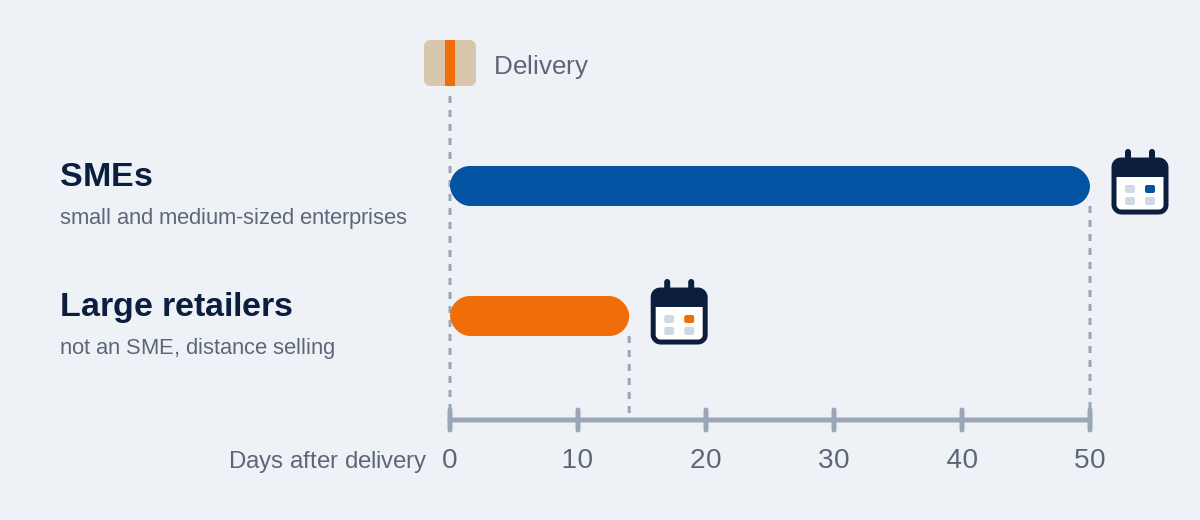
By the way, PayPal draws the same lines for purchase on invoice with Ratepay.
Factoring remains an open question. If a shop sells its receivables, it loses the exemption, according to the retailers’ association Händlerbund. Other lawyers read the law differently: they consider the mere sale of the receivable harmless. So if you use factoring, have your contract reviewed. Ideally before the holiday season.
Checklist – What online retailers should check now
Finally, the practical test: seven questions, and you’ll know where your shop stands with the Consumer Credit Directive:
You can check off the last point without doing the math yourself. AccountOne automatically fetches the data from Klarna, PayPal and co., matches every payment and refund to its sale and hands everything over to your tax advisor, ready for DATEV.
07Frequently asked questions
What is the EU Consumer Credit Directive?
The Consumer Credit Directive is an EU directive from 2023. It governs when and how creditors may lend money to consumers and is meant to protect against over-indebtedness.
When does the EU Consumer Credit Directive have to be transposed into national law?
The deadline expired on November 20, 2025, and Germany missed it. The new rules still apply to all agreements from November 20, 2026.
Does buy now, pay later now count as credit?
Yes. “Pay in 30 days” or interest-free installments via Klarna or PayPal now count as consumer loans, even for small amounts and without interest.
Do I, as a retailer, have to assess creditworthiness?
No. Klarna, PayPal and co. take care of that as creditors. You’ll still feel the consequences, though, because more customers may be rejected.
Can I keep selling on invoice myself?
Yes, if the purchase on invoice is free of charge and the payment term is no more than 50 days (SMEs) or 14 days (large retailers).
What happens if the warning is missing from the advertising?
Then the advertising is unfair, and competitors can send a cease-and-desist letter. That’s why “Achtung! Kreditaufnahme kostet Geld.” (“Warning! Borrowing money costs money.”) belongs directly next to every ad for installment purchases or “pay later.”
08Sources
- Gesetz zur Umsetzung der Richtlinie (EU) 2023/2225 über Verbraucherkreditverträge vom 12. Mai 2026, BGBl. 2026 I Nr. 139
- Deutscher Bundestag, Drucksache 21/1851, Gesetzentwurf der Bundesregierung (29.09.2025)
- BaFin, „Buy now, pay later: Jede(r) Siebte verliert schon mal den Überblick“ (02.02.2026)
- Richtlinie 2008/48/EG über Verbraucherkreditverträge
- Empfehlung der Kommission 2003/361/EG zur Definition der KMU
- Noerr, „Gesetz zur Umsetzung der Verbraucherkreditrichtlinie 2023 beschlossen“ (17.04.2026)
- ITMR Rechtsanwälte, „BNPL-Checkout: Händlerpflichten ab 20.11.2026“ (Rechtsstand 09.08.2026)
- Händlerbund, Ratgeber „Verbraucherkreditrichtlinie 2026“ (Stand 08.10.2026)
- Händlerbund, „BNPL-Regulierung: Das ändert sich für deinen Shop“ (13.11.2026)
- PayPal, „Buy Now, Pay Later (BNPL) und die neue Verbraucherkreditrichtlinie (CCD II)“
- PayPal, Änderungen der Nutzungsbedingungen für Rechnungskauf mit Ratepay (13.10.2026)
- Klarna, Partner Marketing Legal Guidelines Germany
Enjoying what you’re reading? Then you might also like these:
Accounting · Integrations
Taxes on eBay sales – three things every seller needs to know
Tax-free or not, exemption limit, reporting to the tax office, GoBD: what you need to know when you sell on eBay.
Integrations
Interfaces explained simply – When systems understand each other
User interface, software interface, API: what the term means and how data gets from your shop and marketplace into your accounting.

AccountOne
Customer Engagement Day 2026 – AccountOne celebrates its customers
Between networking, product news and a huge thank-you: on 6 November 2026, AccountOne invited tax advisors and selected online retailers to Hamburg.