Integrations
Interfaces explained simply – When systems understand each other
Without interfaces, every piece of software just talks to itself. An order in your online shop, the invoice in your accounting, the contact in your CRM: for this data not to turn into gibberish, systems have to talk to each other. That's exactly what interfaces do – mostly unnoticed and often underestimated.
If you spread your processes across several programs, you depend on interfaces. But what does the term actually mean? How do user interface, software interface and API differ? And how does data from your shop and marketplace find its way into your accounting? Here you'll learn what makes an interface and how it works in everyday life.
Key points at a glance
- An interface (in German: Schnittstelle) is the connection point between two functional units where data or control signals travel back and forth.
- The most familiar is the user interface, which handles communication between people and systems. Since 2020, the international standard has said: working isn't enough, the interface should be inviting.
- A software interface defines which data a piece of software reveals, in which format and in response to which request. The term IT interface also includes hardware, from the network port to the data export.
- Which data a piece of software reveals is usually up to the provider. For cloud services, the EU has had a say since September 2025: the Data Act requires open interfaces for switching providers.
- Through an API, one program orders what it needs from another. If it is publicly documented and released for third parties, it is called an open API.
- CRM and ERP only become a whole through an interface. In online retail, interfaces retrieve the data from your shop, payment service and bank account, match it and hand it over in batches to your accounting.
Understanding interfaces – The term and examples in a nutshell
An interface (in German: Schnittstelle) is first and foremost a point of contact. The German Duden dictionary calls it a seam where two areas meet. In IT, however, the term gets sharper: it means the connection point between functional units where data or control signals travel back and forth.
Examples? Everywhere!

USB port on a laptop
Device meets device
Display on a card terminal
Human meets machine
Export from an online shop
Program meets program
The most familiar is the user interface. It handles communication between people and systems. In 2020, the international standard for good usability added a new principle: working isn't enough. Rather, a user interface should be so inviting that people enjoy working with it.
That's exactly the standard we set ourselves at AccountOne – so you enjoy opening your accounting data.
Software meets software – When systems talk to each other
Software interfaces and IT interfaces explained simply
Two programs, no common language. This is where the software interface steps in. It defines which data a piece of software reveals, in which format and in response to which request. Invisible, but binding.
IT interface is the older, broader term. It covers programs as well as hardware: the network port on your computer just as much as the data export from your accounting software.
Which data a piece of software reveals is usually up to the provider. For cloud services, the EU has had a say since September 2025.
The Data Act requires that customers can take their data with them via open interfaces when they switch. From January 2027, switching charges will be abolished.
For the software sector, that's a signal: openness is becoming mandatory.
Software development – Interfaces between teams and modules
April 1968. Computer scientist Melvin Conway publishes a thesis that is known today as Conway's law: organizations build systems that copy their own communication structures. For software development, this means: wherever two teams work together, an interface runs between their parts of the program. What the teams don't tell each other will later be missing from the interface.
That's why every interface is also a reflection of agreements. In 1972, computer scientist David Parnas describes what good agreements look like: each module of a piece of software only shows the outside world what others need to know. The rest stays hidden. On purpose. That way, one module can be changed without touching the others.
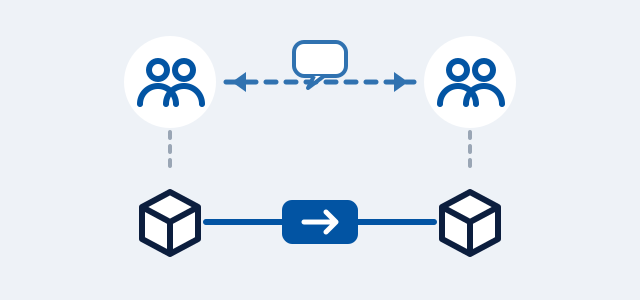
Communication works
- Teams agree with each other
- Modules show what's needed
- The interface reflects it
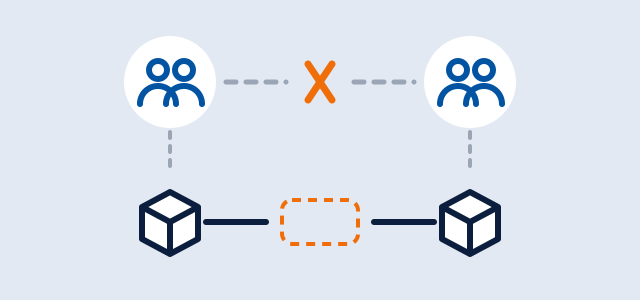
Communication breaks down
- Teams talk past each other
- An agreement is missing
- The interface is missing it too
Data exchange – How data-oriented interfaces create connections
Exchanging data via interfaces – Here's how it works
How does an invoice get from your shop into your accounting?
- Trigger: One system sends a request.
- Format: The data transfer follows an agreed format.
- Check: The target system reads and imports it.
Data-oriented interfaces come in at the second step. They don't pass on commands, but records with a fixed structure. With e-invoices, it is strictly specified which field contains the invoice number, date and amount.
Why so strict? A program doesn't know what an invoice number is. It only knows which field it's in. If the mapping is right, everything runs on its own. If it isn't, the amount ends up where the date belongs. Or it's missing altogether.
Mapping is right
- Invoice number → RE-2026-0815
- Date → 10/12/2026
- Amount → €119.00
Mapping is wrong
- Invoice number → 10/12/2026
- Date → €119.00
- Amount → missing
Every number in the right field. AccountOne makes sure of that.
APIs and integrations – The interface in software
API stands for Application Programming Interface (in German: Programmierschnittstelle). Through it, one program orders what it needs from another: a customer record, an account balance, a tracking number.
Every API is an interface, but not every interface is an API. A USB port connects devices, a display connects people and machines. In short: an API connects programs. Such connections give rise to an integration: the shop asks the payment service whether an order has been paid. Only then does it release the order for shipping.
If an API is publicly documented and released for third parties, it is called an open API. That makes it one form of the open interfaces the Data Act has in mind.
CRM, ERP, accounting – Interfaces in your business
Two abbreviations, two worlds. The CRM (Customer Relationship Management) knows your customers: inquiries, quotes, conversations. The ERP (Enterprise Resource Planning) knows your operations: warehouse, purchasing, invoices. Only an interface turns the two into a whole. A new customer in the CRM then shows up in the ERP without anyone typing.
In online retail, though, the trickiest chain lies elsewhere. A sale leaves traces in your shop, at the payment service and in your bank account. Before it turns into a booking, three things happen:
- Retrieve: Interfaces fetch orders, payments and payouts.
- Match: Every payment finds its order.
- Hand over: The finished bookings go to your accounting in batches, for example for use in DATEV.
Whether shop, marketplace or payment service: we have the right integration for the most important systems.
05Frequently asked questions
What is an interface?
An interface (in German: Schnittstelle) is the connection point between two functional units. Data or control signals travel back and forth through it.
What is the difference between an interface and an API?
“Interface” is the umbrella term, an API is one specific kind. So every API is an interface, but not every interface is an API. An API connects programs, for example when the shop asks the payment service whether an order has been paid. It is different with the USB port, which connects devices, or the display on a card terminal, which mediates between people and machines. They are interfaces, but not APIs.
What is a user interface?
The user interface handles communication between people and systems, for example via the display on a card terminal.
How does sales data get from your shop and marketplace into your accounting?
Interfaces fetch orders, payments and payouts and match them. They then hand over the finished bookings in batches to your accounting, for example to DATEV.
06Sources
- Duden: Schnittstelle
- International Organization for Standardization (2020): ISO 9241-110:2020 – Ergonomics of human-system interaction – Part 110: Interaction principles
- DIN Media (2020): DIN EN ISO 9241-110:2020 – Ergonomie der Mensch-System-Interaktion – Teil 110: Interaktionsprinzipien
- Europäische Kommission: Data Act
- Bundesnetzagentur: Glossar Data Act – Switching charge
- Conway, Melvin E. (1968): How Do Committees Invent? Datamation
- Cunningham, H. Conrad (2013): Notes on Parnas’ “On the Criteria to Be Used in Decomposing Systems into Modules”. University of Mississippi
- Finanzämter Baden-Württemberg / Oberfinanzdirektion Karlsruhe (2024): Einführung der verpflichtenden E-Rechnung zum 1. Januar 2025
Enjoying what you’re reading? Then you might also like these:
OSS & compliance · Integrations
Consumer Credit Directive – When “pay later” becomes credit
Since November 20, BNPL counts as credit. What the Consumer Credit Directive means for your checkout, your advertising and your purchase on invoice.
Accounting · Integrations
Taxes on eBay sales – three things every seller needs to know
Tax-free or not, exemption limit, reporting to the tax office, GoBD: what you need to know when you sell on eBay.
AccountOne
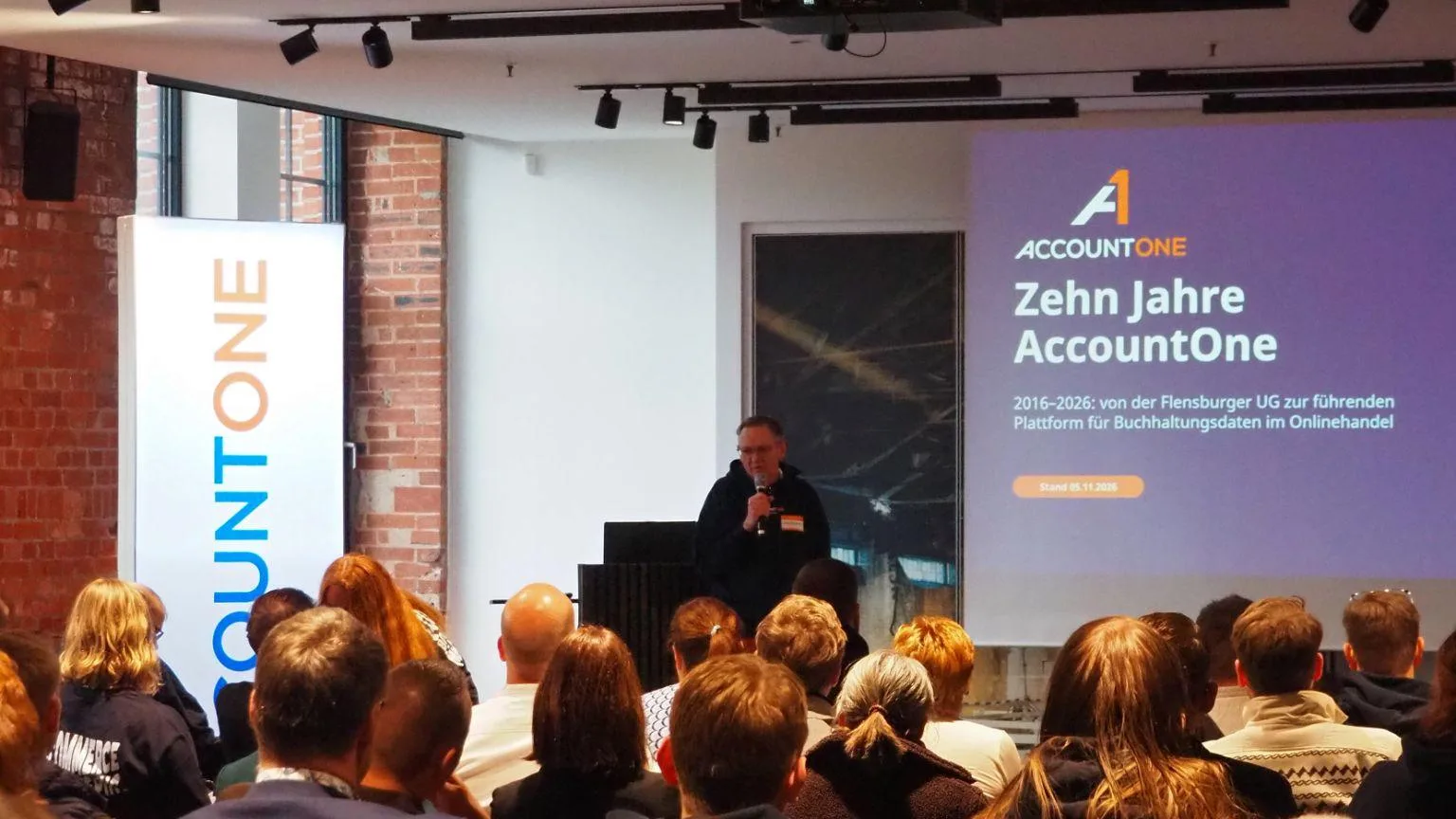
Customer Engagement Day 2026 – AccountOne celebrates its customers
Between networking, product news and a huge thank-you: on 6 November 2026, AccountOne invited tax advisors and selected online retailers to Hamburg.